Home » John Stuart Mill and Liberty
John Stuart Mill and Liberty
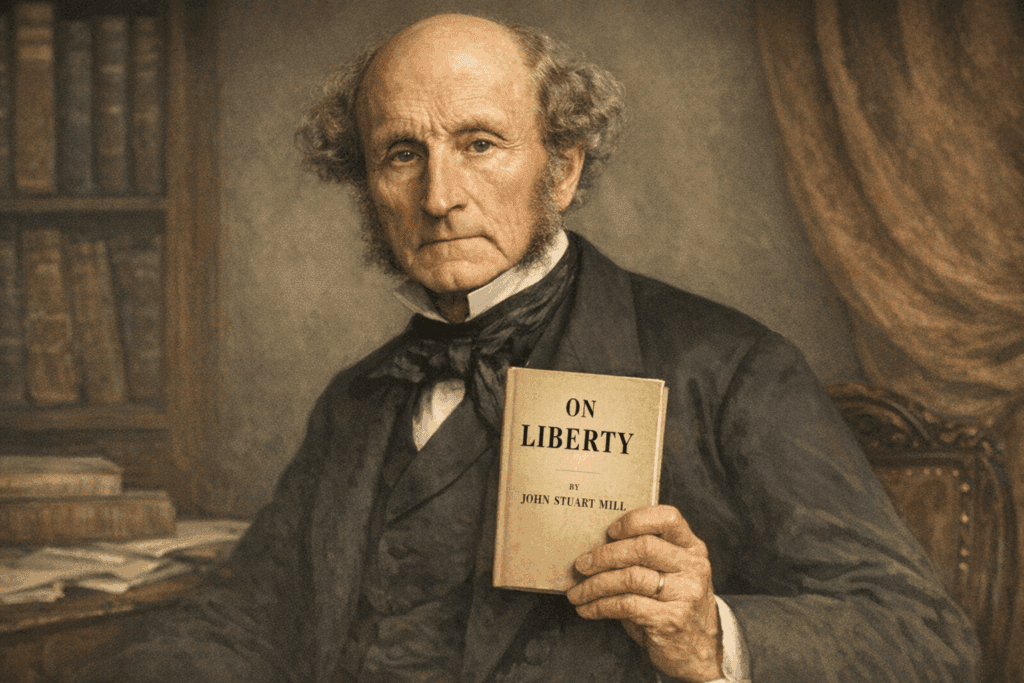
Since high school, I have been aware of Mill as a prominent philosopher who helped develop utilitarianism as a system of moral philosophy. But it wasn’t until I read Mill’s “On Liberty” much later in life that I understood his genius. I include “On Liberty” among my top ten nonfiction books. It presents the finest arguments for liberty I have read.
Liberty is a foundation of Western society, something I took largely for granted. I wanted as much freedom as possible to pursue my vague notion of happiness. I had only a superficial understanding of why liberty was important. Mill changed that. I learned that liberty is more than a preference; it is a necessary condition for individuals and societies to learn and progress.
The Utilitarian Context
Mill was one of the original utilitarians. Individual and societal happiness was the goal for living. People should organize society and live in a way that maximizes happiness. But that philosophy raises two key questions: 1) What is happiness? And 2) How do you achieve it? Being a reason-based, non-theological system, utilitarians could not rely on divine revelation for guidance.
The guidelines for living well in this context are not permanent or unchangeable. While many are well tested and accepted, improvement is still needed. These changes need to be determined through reason and discovery. Our knowledge is limited, and conditions change, making reason alone insufficient. There are many ways reason can fail us. Innovation, experimentation, and discovery must augment it. That type of learning cannot happen without liberty.
Epistemological Humility
Mill’s view of liberty appealed to me because it comes from a position of humility. As a natural skeptic, I am often uncertain of the right course of action and resist those who seem to have unquestioned confidence in their beliefs. Mill approaches living understanding that we have much to learn and that we could be wrong. That perspective was consistent with my experience.
Liberty arising from humility about what we know also is an antidote to power built on certainty of belief. Liberty allows questioning of assumptions, logic, and conclusions. That questioning provides a check on those convinced of their view of how to live and intent on imposing it on others.
An essential part of Mill’s humility is the belief that human reason alone cannot produce all the answers. We have limited reasoning abilities. Humans have many innate biases that warp our reasoning. Reason and logic are not foolproof because they are always based on assumptions that may be wrong. The world and humans are complex, often exceeding our ability to reason reliably.
Humility about what we know and our ability to know something has been an important principle in my philosophical development. Mill’s thinking reinforced my natural questioning and skepticism. Perhaps my uncertainty about things is a strength and well attuned to reality.
Liberty and Learning
The role of liberty in happiness is not just theoretical. History and experience confirm it.
Individual and societal happiness rests on continual learning. Society is not perfect, but there has been continual improvement, in part because of liberty. That was an important topic during Mill’s lifetime, when fundamental human issues such as slavery and the role of women were actively debated and changes made. Taking steps in the interest of progress is necessary even when there is uncertainty and some steps may be wrong.
Liberty now becomes essential because it facilitates change and experimentation. A rigid society with many constraining laws and cultural controls does not try many new things. But increase freedom and liberty and social innovation flourishes. People propose and try new ideas, new ways of organizing society, new ways of cooperating with others, and new behaviors.
Our intellect can help us innovate and create new ways to live that could be better than the old. But we cannot test new ideas solely in our minds. We must test them in the real world. Only then can the effects of a new idea, good and bad, be determined.
This process works for science, which requires experiments to verify theories. It is true for evolution, where random mutations either improve survival or they do not. It is true for businesses where many new products fail for every one that succeeds. Why should it not also be true for something as complex as how to live a good and moral life? Experiments in living facilitated by liberty help answer the questions of what happiness is and how we achieve it.
Liberty, as a widely accepted principle, is a fairly new in human history. For much of human history, strict rules and conventions governed our lives. Experimentation and non-conformity were rare. Technological and social innovation was very slow for many millennia, in part because of social constraints. While obtaining freedom was costly, more freedom led to rapid improvement in social conditions in the last couple of centuries.
There are many examples of this principle at work. It appears in everything from women’s equality, liberal democracy, and gay rights. It is easy to see in retrospect how liberty was essential in producing societies more conducive to individual and overall happiness.
The Value of Bad Examples
One aspect of liberty always bothered me. Give people too much liberty, and they inevitably do things that are not in their best interests. Parents are acutely aware of this as they watch children gain independence and then make poor decisions. How could this be a good thing?
Mill provides some answers. He argues that we learn from poor decisions. That happens in two ways. The person making a poor decision will experience the negative consequences and should make better decisions the next time. And others, observing the person making a mistake, will learn from the example. My experience confirms this reasoning. Often, people learn best through experience and real-world examples.
Another side of the argument is the harm caused by efforts to prevent unacceptable behavior. Mill doesn’t endorse inappropriate behavior, but he recognizes that often the controls necessary to prevent mistakes also prevent new ideas that benefit society. Liberty has some downsides, but it is better than the alternative.
Mill’s thinking on this changed my behavior. My natural inclination when encountering people making poor decisions is to stop them and tell them what they should do. Who wants to watch someone make a big mistake? Now I am much more tolerant of people making mistakes. I will gladly share my advice if asked. And I will be proactive with people close to me and about to make serious mistakes. But I am much more relaxed about letting people make decisions I think are wrong. And I remind myself that perhaps I am the one who is wrong.
The Question of Harm
The harm issue presents a major problem with the argument for liberty. What if a person exercising their liberty causes someone else harm or restricts their liberty? Where do you draw the line to prevent one person’s liberty from infringing on another’s rights?
Mill makes avoiding harm to others a critical limit on liberty. He argued that society (government and social sanctions) should allow as much liberty as possible provided the exercise of that liberty does not harm others. But defining harm and determining how to protect others deserve much thought. Mill establishes this important principle for limiting freedom, but its application is more complex than it might seem.
There are some well-accepted limits on freedom, such as laws on murder, assault, and stealing. But what if someone does something that clearly harms themselves but the harm to others is less direct and perhaps avoidable? Consider a drug addict who abandons their family or is psychologically abusive. Does the avoiding harm to others principle suggest restricting the liberty of the drug addict?
My views on the best balance between liberty and preventing harm have changed. I once fell strongly on the side of liberty. Let people do what they want unless it poses a serious and immediate risk to others. I now understand better how connected we all are. It is nearly impossible for a person to harm themselves but not harm others in some manner, even if that harm is indirect. Determining when and how to restrict liberty to prevent harm involves considering factors such as the type of harm, its extent, and whether the harm is avoidable. Each case has its own circumstances. The correct balance between liberty and protecting others from harm requires thought and wisdom.
Implications
Mill’s logical basis for making liberty an important moral principle moved me from a superficial, almost rote support for liberty to a deep and committed support. A fuller understanding of this principle has provided good guidelines on how to get the most benefit from liberty while avoiding the most serious consequences.
I have learned to accept some behavior in the name of liberty where my instinct was to suppress it. This includes speech but also lifestyle. For example, I find polyamory a bad idea for many reasons. But perhaps it is good to allow people to try it. The outcome, good or bad, will be a lesson for others.
At the other end, I understand better how people who think their actions only affect them can harm society. I still favor using the government only as a last resort when too much liberty causes significant harm to others that is unavoidable. But I am more supportive of social sanctions and disapproval as a legitimate way of discouraging the abuse of freedom.
Mill’s writing reinforced the value of humility, which is a philosophical foundation for liberty. Liberty, in turn, makes possible the experimentation and innovation essential for human progress. These have become core philosophical principles for me.
Add text
You may be interested in these essays:
Is Controlling Our Desires a Key to Happiness?
Return to Essays on How to Live and Table of Contents
Subscribe to my Substack Posts: Robin Gates Essays | Substack
Subscribe
0 Comments
Newest
Oldest
Most Voted
Inline Feedbacks
View all comments